SEO for Artists: An artist’s guide to getting found online
I’ve worked in SEO and digital marketing for over a decade now, so I’ve seen how it works for every type of company and individual going. I’ve worked with artists, accountants, comedy writers, estate agents and everything in between.
The main thing I’ve learned is that even though the bones of SEO is essentially the same for everyone, the approach is vastly different. This is especially true for artists trying to get found online.
To help you better understand what SEO is and how you need to be using it within your art business - or if you need to be using it at all for that matter - I’ve put together this guide to help.
What is SEO and how does it work?
Let’s start with the basics. SEO is an acronym which stands for Search Engine Optimisation, it refers to the act of making online content - website pages, images, videos and even social media content - easy to find by search engines like Google.
Search engines act like librarians, they scour the internet and find content. They then get to work cataloguing and indexing everything they find so that when someone comes to them looking for an answer, they have the resources to deliver to them.
What do search engines look for when deciding how to index content?
The answer to this has changed dramatically over the last five years. Before, search engines would look for keywords and other signals like websites pointing the way to other websites through links. Now though, it’s all about relevancy, helpfulness and the authority.
To put this simply, search engines now look for the following when deciding how to index the content it finds online:
Keywords and topic - these still matter as they help the robots doing the indexing to understand what your website, images, videos etc. are about.
Expertise and Experience - search engines want to be able to see that the person behind the online content knows what they’re talking about. They want to be able to serve results to their users that are legit and verified.
Trustworthiness - search engines only want to use content that has proven to be trustworthy. The way it does this is to look at what other content is referencing or pointing to it. For example, if the BBC website is linking to an article, search engines will see that as a very strong trust signal, because the BBC has already proven itself to be trustworthy and so its recommendation via link to the other content is also to be trusted.
How do search engines decide which online content to serve its users?
This is where the trustworthiness comes in. Search engines like Google want to serve its users only the content that is going to be the most relevant and the most legit.
If someone types into Google, ‘portrait artist in Liverpool’, then the search engine will look for any online content that makes it very clear its about portrait artistry in Liverpool via its keywords and page copy. It will also look at whether other websites are linking to that content, to see if it has any ‘recommendations’ from other online content.
The one thing I want to make clear at this point is that Google is an enigma, they will give us a general idea of how it chooses its content, but there’s also a lot of factors it keeps close to its chest so people can’t cheat the system. For example, I’ve seen blog posts appear in the top spot in search results with absolutely no links back to it and its been simply because it was extremely relevent and helpful content.
All of these things are guidelines, so if you create a website that is clear concise and makes it glaringly obvious what its offering, you have just as much chance as anyone in appearing in search results.
Where do you need to implement SEO?
Now we’ve covered what SEO is in all its complicated glory, now it’s time to look at how you get it to work. Here I’ll only focus on SEO from an artist’s POV to hopefully make it as helpful as possible and ignore all the overcomplicated stuff that you don’t need to worry about.
The main places, as an artist, that you’ll be implementing SEO is on your online portfolio or website.
Luckily for all of us, many website management platforms today will have their own SEO tools that you can use to make it super easy to cover the basics. Some of the website platforms that have great SEO tools are:
Wix
Squarespace
Shopify
Big Cartel
Wordpress also has SEO plugins such as Yoast SEO, but if you’re looking for ease, I’d opt for one of the above, as Wordpress can be tricky to manage long-term without the help of a developer.
The main SEO tasks you’ll want to look at include the following:
Meta titles and descriptions
These are often the main things built in SEO tools cover. A meta title is simply the title that appears in search engine results, the clickable blue headline on the result. The meta description is the little paragraph found below the clickable title.
The role of meta titles and descriptions are to make it as clear as possible to people looking at search engine results, what the website or page is about. It’s there to encourage people to click on your result and needs to also include keywords to help search engines to understand what the page is about.
Below is a result taken from my search for ‘portrait artist Liverpool’. You can see the meta title ‘Best Portrait Painter Merseyside - Hazel Morgan’ and the meta description below that ‘Beautiful oil portrait paintings & equestrian paintings from photos or sittings by award-winning artist Hazel Morgan. Portrait Painter Merseyside.’

Image alt text
The image alt text is primarily for people who use screen readers, but its also a great place to get some keywords into your content. This can also be a great way to get images to appear in image results as well.
Headers
Headings help to tell search engines what’s the most important parts of a website page or blog post. The most important is formatted as a H1, the next a H2 and so on.
Every page should have only one H1 that includes the main keyword you want that page or post to appear in search engine results for. For example, you’ll see that the H1 for this post is ‘SEO for Artists: An artist’s guide to getting found online’ with ‘SEO for artists’ being my main keyword.
You should then look to include other related keywords in H2 headings, of which you can have as many as you like.
I always approach headings as a way to give my pages structure first and then think about keywords second. This allows me to make sure that any pages or blogs I create, make sense for real humans first and robots second.
Keywords and relevant information in the content
This is where the bulk of the work will take place. Whether its a blog you’ve written for your website or if its a website page, you need to be making sure that the words on the page or website as a whole, makes it abundantly clear as to what you are offering.
You do this by including keywords in the content on the page. Let’s look at the page we’re taken to when we click on Hazel’s result we looked at earlier:
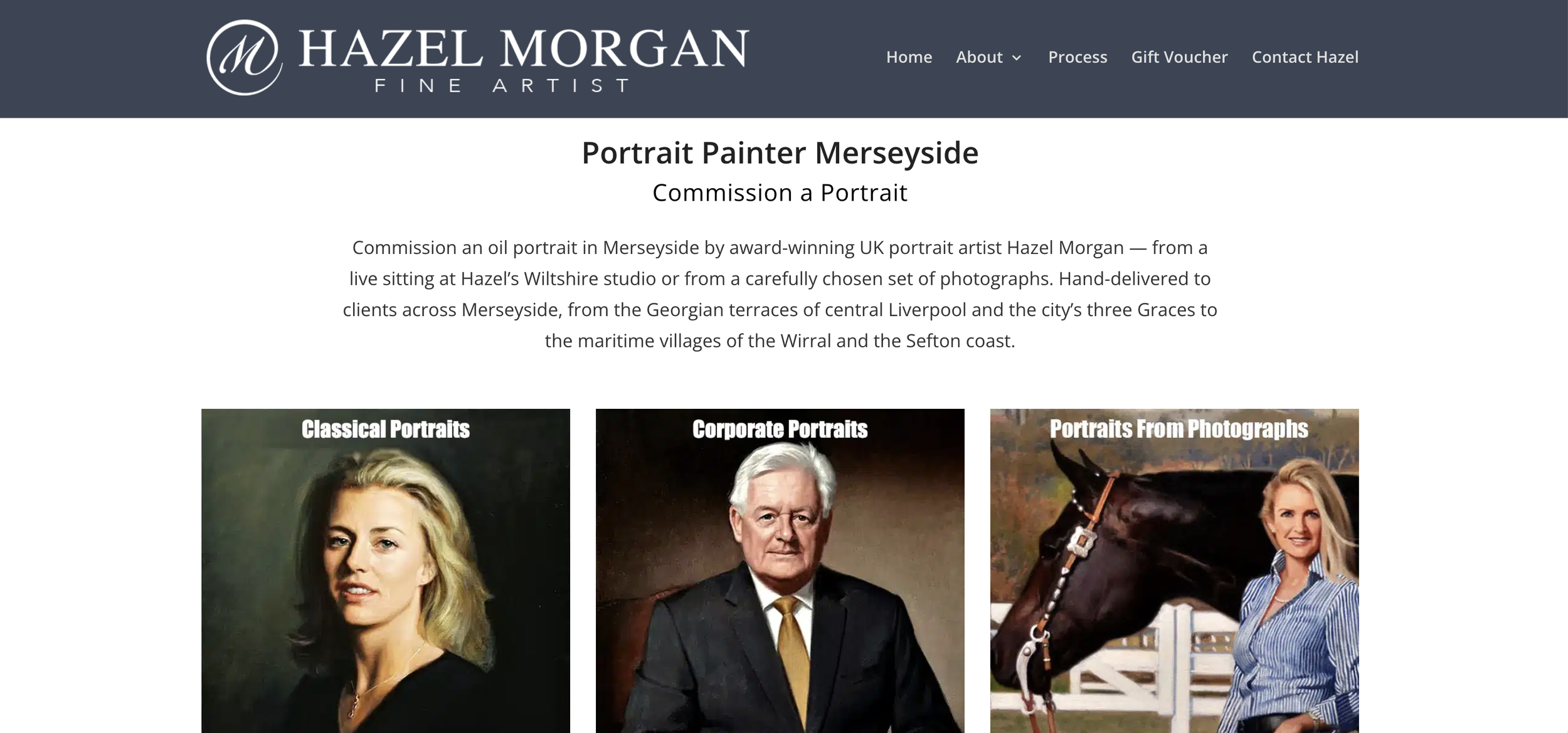
As soon as you land on her website, there is a clear heading telling you exactly what the website is about ‘Portrait Painter Merseyside’ a clear call to action (what she wants people who land on her website to do) ‘Commission a Portrait’ and a paragraph which includes all the information that both Google and users need to understand what the website is about.
Below, I’ve highlighted in green the keywords she’s used to help search engines to understand what her website is about as well as highlighting the trust signals we talked about earlier (in purple). Using a combination of keywords, location keywords and trust signals, she’s managed to create the perfect storm for SEO.
“Commission an oil portrait in Merseyside by award-winning UK portrait artist Hazel Morgan — from a live sitting at Hazel’s Wiltshire studio or from a carefully chosen set of photographs. Hand-delivered to clients across Merseyside, from the Georgian terraces of central Liverpool and the city’s three Graces to the maritime villages of the Wirral and the Sefton coast.”
And this is just the opening paragraph, there is so much more, carefully written content that has clearly been written with SEO in mind, go and check out the page by clicking here.
Should artists bother with SEO?
People often assume that if you have a website you need SEO, but actually it depends what your website or online portfolio is for. When you created it did you want it so people could find you on their own time? Or did you create it simply as a shop front, a place to direct people who want to find out more about you and your work.
If you’re not sure if you even need SEO, answer the following questions:
Are people actively using search engines to find your art?
Does your art need to speak for itself? i.e. people need to see it in order to connect with it
Who are you hoping will find you through search engines or social channels?
How much work is going to be required for you to compete for the search terms you think you need to show up for?
Are people actively using search engines to find your art?
When you think about the type of people that buy your work - and if you haven’t thought about it, I highly recommend reading my blog about marketing your artwork in a sustainable way - are they sitting down at Google and actively searching for what you offer?
If you offer a local service such as Hazel who we met before, then SEO might be your number one marketing tool. This is because it’s highly likely that if someone if looking to get a portrait commissioned, they will use Google to find the best person for the job.
The same goes for if you offer workshops, events or online courses in your art business. These are all things that people would realistically search for using a search engine.
However, if you don’t offer commissions or on-demand services like courses or workshops, if you simply want to sell or exhibit original artwork, SEO might not be essential.
At the end of the day, SEO is a marketing tool, and as we covered in my guide ‘Choosing the right marketing platforms and how to use them’, you don’t have to put your limited time and energy into areas that aren’t going to offer you maximum return. Which leads us onto my next point…
Does your art need to speak for itself? i.e. people need to see it in order to connect with it
If so, then your website will want to be heavily image focused, more of a portfolio or online personal gallery. It also means that you might want to focus more on more visual marketing tools such as Instagram or Pinterest.
You can dive into the world of image SEO, making sure your images are appearing in Google image searches, but it’s worth noting that the people using image searches are probably not looking to buy artwork and are more likely looking for inspiration or to use images in their own content.
Who are you hoping will find you through search engines or social channels?
This is where getting clear about who might want to buy your work is essential. Again, if you haven’t read my guide on marketing your art sustainably I recommend it, as we go into depth about how to figure this out.
Knowing who will want to buy your work and why, will also help you to figure out how those people may come across and choose to buy your work. SEO works best when targeted to those who are actively looking for a product or service, that’s why big corporations spend millions every year on professional SEO, because their customers are most likely to be using search engines.
All of this also applies to social media channels like TikTok, Instagram, Pinterest and even YouTube. Over the last few years, more and more people have been using social platforms as search engines and now you can use your SEO skills to also get found on social platforms. So don’t just think about search engines like Google, also think about those users that might be using social tools as search engines.
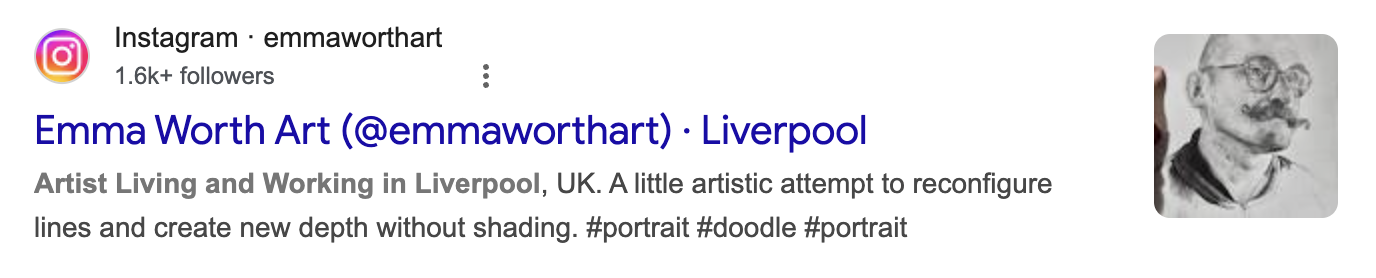
It’s also worth mentioning that social media posts and profiles now appear in Google search results, so it’s always worth applying your SEO knowledge to your Instagram posts.
How much work is going to be required for you to compete for the search terms you think you need to show up for?
I won’t lie to you, SEO is one of the most rewarding but also the most frustrating marketing tools. Search results change by the second and websites that appear in the top spot one minute might disappear from view the next.
I think of search engine result pages as a mountain that everybody is clambering to reach the summit of all at the same time. The more people that optimise their content for the same keywords and topics, the more people you have to fight with to reach that summit.
This is why I highly recommend getting very niche when it comes to deciding what search results you want to appear for. Broader and more general terms will always be more difficult and require a lot more work and expertise than those that are not as popular.
For example, the term we used before, portrait artist Liverpool, is a fairly broad term and will be highly competitive, making it more work when it comes to SEO.
However, the term ‘oil portrait artist from photo Liverpool’ is something we call a ‘high intent’ keyword, meaning that anyone who is using that to search for what they want, are most likely very sure in what they are looking for and more likely to buy or get in touch. This is a super niche search term, which means that it will have less competition and therefore be a little easier to appear for, not to mention be more rewarding for your art business if it pays off.
How artists can get started with SEO
Now it’s time to put knowledge into action, let’s have a look at how you can practically start implementing SEO so that you can start to be found online.
Understanding user intentions
Before you sit down to optimise your website or portfolio for search engines, you need to know what your website user’s intention is. User intent is how search engines decide which resource is going to be the most helpful for the person searching.
User intent most commonly falls into one of three categories:
Informational - people using search engines for research or browsing purposes, often looking for answers to questions beginning with how, what, where or when.
Commercial - people who are actively looking to purchase or enquire about a specific product or service.
Navigational - people looking for a specific brand or web page.
When deciding what to optimise your website for, you need to know which of the above your audience will fall into. Different pages on your website might serve different user intents, so keep that in mind. For example:
About page - this will serve users with an informational intent, because if someone is looking at your about page they are looking for information about you or what you offer.
Online store, product, gallery or service page - these will serve users with a commercial intent, as you’ll want to attract those that are actively looking for what you’re selling.
Understanding this will influence the type of information you put on each website page as well as the type of language you use and what calls to action you use on the pages.
Knowing what keywords and queries to optimise for
Once you know what the user’s intentions are when they land on your website, it will be easier to think about what kind of search terms they might type into a search engine in order to find you.
Doing keyword research doesn’t have to take up too much time, I swear by free tools like AlsoAsked and Answer the Public. These are tools that allow you to type in what you think someone might type into Google, it then gives you a variety of other search terms that are related, to help you get an idea of other things people might search for that you can use to optimise. If you’re not anti-AI you can also ask tools such as Claude or Perplexity to give you keywords that might be useful to optimise for.
For artists, a great way to think about keywords is to think about adjectives people might use to describe your art. This is the most common way someone might search for art using search engines, for example:
Blue and cream art for living room
Large surrealism art work
Bold art print for bathroom
Moody oil painting art print
You can also use specific rooms or environments to further narrow down your search terms, just like I did above with words like living room and bathroom. If you create work that businesses might like such as cafes or restaurants, make sure to optimise for those words too.
Make sure to always include keywords in an organic way. The content on your website needs to be understandable and easy to read by humans first, so don’t think you have to put the keywords in constantly as this is known as keyword stuffing and can actually be a negative impact on your SEO. Aim for 1-2 keywords per 500 words.
Building an SEO optimised website
When it comes to building an SEO optimised artists website, it’s important that you choose a website platform that feels easy for you to use and update and that also has those in-built SEO tools that can make things a little easier for you.
Think about what the intention of each page on your website is, just like we talked about before, and optimise for keywords and search terms that people are most likely to type in if they’re looking for the information that page offers.
Make sure you have:
Given every page a meta title and description
Given every page a particular keyword or search term you want it to appear in search engine results for
Link to other pages on your website within the content of each of your pages - for example, just like how I linked to previous blog posts earlier in this article. This helps search engines navigate your website better, as linking between your pages, you create a map for the search engines to use to navigate.
Write copy that offers your users all the information they might be looking for and that includes the right keywords so search engines know what your website page is about.
Thought about how someone might use your website and make it as easy as possible for them to get to where they want to be. User experience also plays a big role in your SEO, so don’t overcomplicate your website with too many pages. You want people to be able to get to where they want to be in one click, two at most.
Creating SEO content
The content on your website or even on your social media profiles, are where the bulk of your SEO work will take place. If you plan in advance, this becomes a lot easier than trying to wing it.
Here’s my personal process for working on SEO content for my clients and for my own site:
Decide on what the user intent is for that blog or page as this will determine the type of language I use on the page or in the post
Keyword research. I think of a few different search terms I think people might type in to find the page or post I’m working on. For example, for this blog I wrote down ‘seo for artists’ as well as longer more question heavy terms like ‘can I do SEO myself as an artist’ amongst others.
Create a clear and concise structure for the page/post and set out the headers to help me decide what is most important on the page. I’ll make sure my H1 has my main keyword in it and then any H2s have my secondary keywords or terms in them.
I personally like to just go with the flow when writing content on a page or in a post and then at the end I go back and add in any keywords I might have missed and place them where they make the most natural sense. I’ve always been told not to do this, but seeing as search engines now care more about whether your content is helpful to its users, I find this is the best process for me to ensure my content sounds like it’s meant to real people and not the robots.
Include any internal links that I might have missed. Usually these come up very naturally as I write the content, but if it doesn’t, I always go back and see where my other blogs or website pages might be useful and link to them.
Create a Call to Action (CTA). Any content, whether it be a website page, product page or a blog post should have some sort of call to action. It might be that once someone has read the page, you want them to get in touch to ask about commissions, or you might want somebody to purchase a print from your shop. This is something artists struggle with, because it requires you to say in a very direct way, “please buy this thing”.
How much copy should be on a page for SEO?
How much writing should be on your website page, portfolio or in your blog post depends on two things:
What the purpose of the page is
How much information a real human would need in order to get the answer they are looking for
On a portfolio or gallery page, you may want as little as 200-300 words to give an introduction to the images a user is going to find on the page, however if you’re writing a blog post, you may include anywhere from 500 words to 2000 words, depending on how much information is needed in order to get your point across.
A page such as an about page might be somewhere in between, ranging between 300 to 500 words. Like any kind of writing, you should always aim to only write copy that has a purpose and not write words simply to fill the page.
SEO for Artists: A checklist
Now that' we’ve come to the end, I wanted to make sure you’ve got a clear summary of what SEO can mean for artists and how you can use SEO as part of your art business marketing, so here is a simplified checklist to help.
Understand what your potential buyers are searching for using search engines
Understand why your potential buyers are searching for those terms e.g. looking for information or looking to buy
Settle on 2-3 different keywords or longer search terms that your potential customers or clients will use to find your website or website page
Decide what the main keyword out of those 2-3 will be for that piece of content
Make sure your main keyword appears in your meta title and description - it also helps if its in the URL of that page e.g. https://www.theslowmarketingclub.com/blog/marketing-for-artists ‘marketing for artists’ is the main keyword and appears in the URL.
Create structure on the page by using the header hierarchy, making sure you have just one H1 that holds your main keyword and the other keywords are sprinkled throughout your H2s.
Write your page copy or blog post with real humans in mind first, robots second.
Include your main keyword in the opening paragraph of the page or post so it’s clear straight away what the page is about.
Include your other keywords naturally as you write your website or page copy and don’t include them more that 1-2 times per 500 words.
Include links to other blogs or pages on your website where it offers the user more information or context.
Include a clear CTA on the page so users know what you want them to do e.g. get in touch, buy, enquire, book
Make sure any images you use have names that include your keywords and have alt tags which do the same.
If you’re feeling overwhelmed by how much information is needed in order to understand SEO don’t worry. As a solo business owner, you’re not expected to understand all the technical information and simply grasping the very basics of SEO can be enough to make a difference to you and your art marketing.
If you’re not already signed up to the bi-weekly Slow Marketing Club newsletter, I recommend you jump on board. I’ll be creating lots more resources to help you get your head around SEO and by being on the mailing list, you’ll also have the chance to get in touch and ask me anything about your own SEO or marketing challenges.
Like I say every time, never forget that you have full control over which marketing channels you use for your business and every channel is optional. It all depends on what feels sustainable and manageable for you and which channels help support you in creating the work you want to create, not take from it.
Speak soon!
Cat x
SEO for Artists FAQs
How long does SEO take to work
SEO is the slowest but most effective form of marketing. How long it takes depends on how often Google indexes your website. Usually, we say 3-6 months to see results from SEO work, but this can be quicker or even slower depending on Google’s preferences. You can force a crawl to speed up your SEO results by requesting it in Google Search Console, but this doesn’t guarantee results.
What keywords should artists use
Artists should use keywords that describes their work in as much detail as possible, using adjectives and other descriptors that a potential buyer may be looking for. Using things such as colour palettes, environments, locations, mediums and size can all prove helpful.
Can I do SEO myself as an artist
Absolutely you can, although you may be limited depending on how easy you understand the many different faces of SEO. The best place to start is with SEO content e.g. content marketing. This means you focus on optimising your website, social profiles, product or artwork pages and spend your time on getting keywords correct and building an online presence that is clear and direct.
Do I need a blog for SEO as an artist
No you do not need a blog for SEO as an artist, however it can be a great support tool to help you optimise your website. You can absolutely have a simple, even one-page website and still have strong SEO. A blog can’t exist just for the sake of it, if you choose to create a blog, think about how it supports your wider marketing and offers value to those visiting your website. A good option is to use a blog to offer a journal of what inspired you or to offer more information about a piece of work.
How often should artists post for SEO
It’s good practice to update your website at least once a month, just so search engines can see your website hasn’t been abandoned and is being actively managed. This can include something as simple as updating the images in your gallery, altering some about text or even doing some small copy tweaks. If you want to include a blog on your artist website, then doing a monthly post can be a great sustainable way to update your site and add to your content marketing.
Does SEO work for Instagram
Yes it does. You can use your SEO knowledge on Instagram posts and profiles to help them appear in search engines. Doing this also ties into the platform’s own algorithms. As social platforms are recognising that people are using them more and more as search engines, their algorithms are slowly aligning with that of Google. For example, focusing on keywords in your Instagram profile, post captions, alt text and even the captions on reels can all help you appear in both Instagram results and search engine results.
What is alt text and why does it matter for artists
Image alt text is used to help those who use screen readers. By including alt text you not only show your content is accessible, but you can also add keywords to the alt text to support the SEO of your overall website or portfolio. For artists, this can be especially important as visual marketing is a key part of art marketing and alt text can help you be found in image searches.
How do I find keywords for my art niche
The best ways to find keywords for your niche is to start with a common search term and build from there. For example, if you create oil paintings of landscapes, you might start with the keyword ‘oil landscape painter’, typing it into Google or one of the keyword research tools mentioned earlier in the article and exploring what other related terms people search for.
Looking at others in your niche and seeing what keywords they include can also be very helpful. Create a list of your findings in your notes app, document or spreadsheet.
